Web Design and Development Trends Heading into 2027
The web now has two audiences: people and AI agents. The best teams are building for both on a browser platform that has become far more capable, and they treat accessibility as a starting constraint.
Why 2027 feels different
Most year-ahead lists are mood boards: a gradient here, a bold serif there. Those trends are real, but they are the surface. Underneath, three forces are reshaping how sites get designed, built and found:
- AI sits on both sides of the website. AI tools help build sites faster, while AI search and AI agents change how visitors arrive and what they do once they are there.
- The browser itself is doing more. Features that once needed JavaScript libraries are becoming native, and browser vendors are actively aligning them.
- Accountability is rising. Accessibility rules, privacy rules and performance metrics increasingly decide whether a site is considered good.
If you remember only one sentence from this post, make it this one: design and build for humans and agents, on the platform, with accessibility as a starting constraint.
Trend 1: The agent-ready web
Browser agents can already click through websites, but they do it clumsily. They work from screenshots and guesses about page structure, and they stumble on things like date pickers and multi-select dropdowns. A flight search form is obvious to a person, yet an agent has no signal that a field wants a three-letter airport code.
The emerging answer is WebMCP, a proposed standard that lets a site publish structured tools that agents can call directly. It offers two paths: an imperative API where developers register tools in JavaScript, and a declarative path where existing HTML forms are annotated with a few attributes. A W3C Community Group draft report appeared in February 2026, and Chrome has been running it as a public origin trial across versions 149 to 156. It is still early, and adoption is the open question.
What this means for your work:
- Treat agent use as a real use case. Booking, support tickets, checkout and search are the obvious candidates for structured tools.
- Keep your security model intact. A structured tool is still an entry point. Run the same access controls and validation on the server that you apply to normal form submissions.
- Design the visible side too. People and agents may use the same interface at once, so decide what the person should see while an agent acts on their behalf.
- Write clean, well-labeled HTML. Even without WebMCP, good labels and semantic structure are what agents fall back on.
A related shift: AI summaries and AI search reduce clicks to many sites. That raises the stakes of every visit and makes clear structure and citable content more valuable.
Trend 2: AI-assisted building becomes the default, and framework choice becomes evidence-based
In 2025 and 2026, AI moved from autocomplete to a core part of the development pipeline. One consequence is that developers are less constrained by what feels pleasant to type, which reopens a long-running question: which stack should we actually use?
A useful data point came in October 2026, when developer Nolan Lawson published a benchmark in which AI agents built the same small content-style app in twelve different frameworks, five runs each. Some takeaways, with the author’s own caveats (a single app type, stochastic AI output, and Lighthouse metrics that favor multi-page sites over single-page apps):
- Performance and accessibility scores were nearly saturated across frameworks, so the interesting differences were elsewhere.
- JavaScript shipped to the browser varied enormously. Astro sent essentially none, while Next.js sent the most, at roughly 142 KiB in the median run.
- Cost and code size varied too. Hono with htmx was the cheapest to build and among the smallest in lines of code, while Angular was the most expensive and largest.
- Newer frameworks can cost more simply because the AI model has not seen them in training, so agents spend tokens reading migration guides.
The lesson is not that one framework wins. It is that in an agent-assisted workflow, the stack you pick affects token cost, maintainability and user-facing weight, and those choices deserve measurement rather than habit. Expect more teams to lean toward server-rendered, lighter-JavaScript architectures for content-heavy sites, while keeping rich client frameworks for genuinely interactive products.
Practical advice for 2027:
- Let AI handle mechanical work, and spend human time on structure, constraints and review.
- Give agents a clear spec, a conformance test suite and design tokens. Output quality tracks the quality of the constraints you provide.
- Benchmark your own app type before standardizing on a stack.
Trend 3: The native web platform catches up
One of the quieter stories of 2026 is Interop 2026, announced in February by a team including Apple, Google, Igalia, Microsoft and Mozilla. It targets features developers have asked for most, and its dashboard tracks cross-browser pass rates through the year. The focus areas read like a wish list:
- Anchor positioning, which places an element relative to another, such as a tooltip next to its trigger.
- View transitions, including cross-document transitions, for smooth page-to-page animation without a heavy client-side router.
- Scroll-driven animations, which tie animation to scroll position.
- Container style queries, which style components based on their container’s custom properties.
- Dialog and popover improvements, including the closedby attribute and popover hint for tooltips.
- The contrast-color() function, which picks a color with guaranteed contrast against another.
- Smaller but useful additions, such as the attr() function, the shape() function, custom highlights and scoped custom element registries.
The pattern across the 2025 to 2026 period is that native features are proving capable of sophisticated web applications. Modals, tooltips, page transitions and scroll effects that once demanded libraries are increasingly a few lines of CSS and HTML. Fewer dependencies mean less JavaScript, fewer breakages and better performance, which also keeps AI-generated code leaner.
Before adopting any of these in production, check current browser support for your audience and use progressive enhancement so older browsers still get a working experience.
Trend 4: Accessibility moves from checklist to constraint
If there is a single design trend that outranks the visual ones, it is treating accessibility as a constraint from the first wireframe rather than a pass at the end of a project. Several forces push in that direction: regulation such as the European Accessibility Act, growing attention to consent and privacy design (including India’s DPDP Rules), and a broader view of inclusion.
That broader view includes cognitive-inclusive design, meaning interfaces that work for different ways of processing information: plain language, predictable navigation, reduced clutter and controls that are easy to find and exit. Dark mode and low-light interfaces are becoming standard options, but they must be built with readable contrast and clear navigation, not just inverted colors.
New platform features help. Functions like contrast-color() make it easier to keep text readable as themes change, and design tokens let you enforce contrast rules centrally.
A good working rule for 2027: if a component cannot be used by keyboard, read by a screen reader and understood at a glance, it is not finished.
Trend 5: Expressive visuals, with restraint
Visually, 2026 leaned expressive, and that carries into 2027. The recurring themes across design publications are:
- Bold, oversized and experimental typography as a primary design element.
- Brighter, more saturated color as designers move away from strictly monochrome minimalism.
- Immersive 3D and interactive elements that give pages a tactile, dimensional feel.
- Micro-interactions and micro-animations that make interfaces feel responsive.
- Proprietary effects and ownable visual treatments, a response to AI tools making generic polish easy to produce. When everyone can generate a clean layout, distinctiveness becomes the differentiator.
- Playful details such as creative 404 pages and small entertaining elements.
The tension to manage is performance and accessibility. Heavy 3D, big animations and decorative effects can hurt load time and exclude users who are sensitive to motion. The teams doing this well pair expressive moments with respect for reduced-motion preferences, sensible loading strategies and native CSS techniques where possible.
Trend 6: Design tokens bridge designers and developers
Design tokens, the named values for color, spacing, type and motion, are becoming the backbone of scalable design systems. They matter more in an AI-assisted workflow because they give both humans and agents a shared, machine-readable vocabulary. When a design file can feed structured context to a development agent, handoff gets smaller and consistency gets easier.
If you do one infrastructure investment in 2027, make it a well-organized token set and a documented component library. It pays off in speed, accessibility and brand consistency.
Trend 7: Websites as tools, not brochures
As AI answers more questions directly, a static brochure site has less reason to exist. Sites that earn visits increasingly offer something to do: calculators, configurators, interactive explainers, planning tools and genuinely useful utilities. These also pair naturally with the agent-ready trend, since a tool with clear inputs and outputs is exactly what an agent can call.
The flip side is how design work gets judged. Designers and developers who can show measurable outcomes, such as better conversion, faster tasks or fewer support requests, are increasingly valued over those who only show attractive mockups.
Trend 8: Performance, measured by responsiveness
Speed work is now framed around real-user responsiveness. Interaction to Next Paint (INP) and the other Core Web Vitals remain the shared yardstick, and the guidance is consistent: ship less JavaScript, render meaningful HTML early, and make interactions feel immediate. This is the practical reason the lighter-stack trend above matters; it is not fashion, it is the metric.
A note on mobile-first and new internet users
For many markets, including India, the next wave of users is mobile-first, often on mid-range devices and variable networks. Lightweight pages, clear language, accessible touch targets and honest consent flows are not niceties there; they decide whether a site is usable at all.
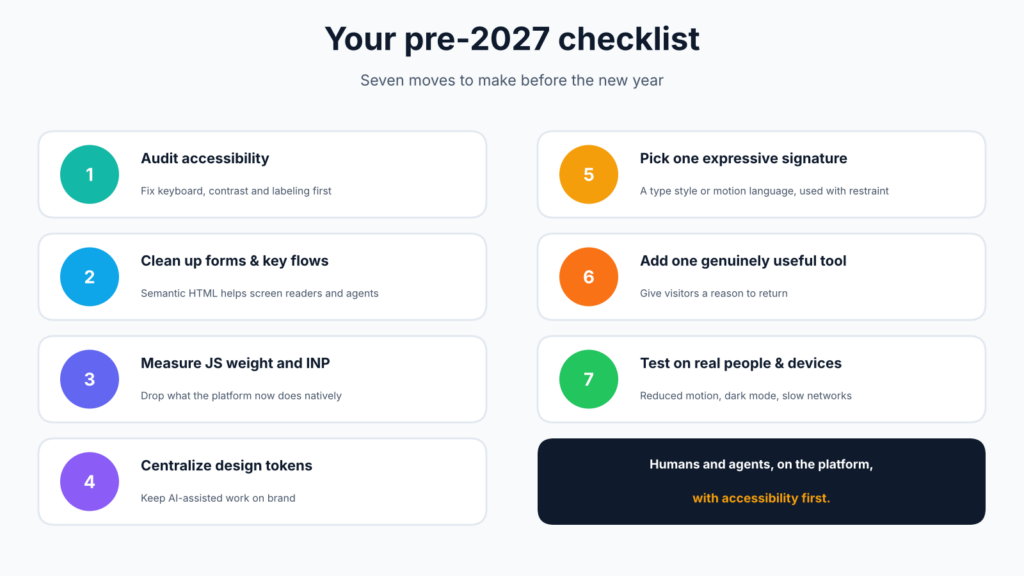
What to do before 2027 arrives
Here is a compact plan you can act on in the next few weeks:
- Audit accessibility against current standards and fix keyboard, contrast and labeling issues first.
- Clean up your forms and key flows with proper labels and semantic HTML, so both screen readers and agents can understand them. Prototype WebMCP on one high-value flow if it fits your roadmap.
- Measure your JavaScript weight and INP, then remove what the platform can now do natively.
- Centralize design tokens and write down your component rules, so AI-assisted work stays on brand.
- Choose one expressive signature, such as a typographic style or motion language, and apply it with restraint.
- Add one genuinely useful tool to your site that gives visitors a reason to return.
- Test with real people and real devices, including reduced motion, dark mode and slower connections.
What to watch with caution
- WebMCP is early. The spec is still being finalized, and it is in an origin trial, so treat it as an experiment rather than a dependency.
- Forecasts are forecasts. Many trend articles, including those this post draws on, label their 2027 points as predictions. The foundations are visible in 2026, but exact outcomes are not guaranteed.
- Benchmarks have limits. The framework comparison above covers one app type; a complex dashboard could rank differently.
- Browser support varies. Verify each new CSS feature against your audience before relying on it.
Conclusion
The web heading into 2027 is more capable, more automated and more accountable than it was a few years ago. The winners will not be the teams chasing every visual fad. They will be the ones who build on the platform instead of piling on dependencies, treat accessibility as a design input, make their sites legible to both people and agents, and prove their work with real outcomes.
The good news is that the fundamentals are the same ones that always worked: clear structure, fast pages, honest design and respect for the people using what you build. In 2027, those fundamentals just get a second audience.